



FreshTrack targets food waste that costs the world $1 trillion a year
FreshTrack targets household food waste with expiry tracking and smarter shopping; even modest waste cuts could translate into meaningful annual savings.
By Bilge Türk | MediCenter TV
ANKARA, TÜRKİYE — Food waste costs the global economy roughly $1 trillion a year, and household-focused tools such as FreshTrack are targeting one of the problem’s most preventable causes: food bought but never eaten.
FreshTrack cannot yet claim a scientifically measured percentage reduction in household food spending. No independent study has established that its users save 10%, 20% or 30%. But United Nations and WRAP data make it possible to estimate the economic opportunity if digital inventory, expiry reminders and smarter shopping help families reduce even a modest share of the food they currently waste.
Food waste is a $1 trillion economic problem
The scale of the potential savings starts with the global numbers.
The UN Environment Programme estimates that 1.05 billion tonnes of food were wasted in 2022 at household, food-service and retail levels. That was equivalent to around 19% of the food available to consumers.

Households were responsible for 631 million tonnes — about 60% of the total. UNEP estimates that the broader economic toll of food loss and waste is roughly $1 trillion a year.
That means even relatively small percentage improvements become economically significant when applied at scale.
As a simple proportional scenario — not a forecast for FreshTrack itself — every 1% reduction in a $1 trillion annual economic loss represents about $10 billion in economic value preserved.
A 10% reduction would correspond to roughly $100 billion.


A 20% reduction would correspond to $200 billion.
A 30% reduction would correspond to $300 billion.
And reaching the UN Sustainable Development Goal of halving food waste would imply a reduction on the order of $500 billion if the economic loss fell proportionally.
These figures should not be interpreted as revenue that any one app could generate. They illustrate the size of the economic problem that food-management technologies are attempting to address.
For families, the savings can reach hundreds each year
The household impact is easier to visualize in pounds rather than billions of dollars.
WRAP estimates that edible food waste costs the average UK household of four about £1,000 a year, or roughly £86 per month. Across UK households, edible food thrown away is worth about £17 billion annually.
If a household currently loses £1,000 a year to food waste, the potential savings under different reduction scenarios would be:
- 10% less waste: about £100 a year
- 20% less waste: about £200 a year
- 30% less waste: about £300 a year
- 50% less waste: about £500 a year
A 30% reduction, for example, would keep around £25 a month in the household budget.
Again, these are scenario calculations. They do not mean FreshTrack has been proven to deliver a 30% reduction.
The actual result would depend on how much a household currently wastes, food prices, family size, shopping habits and — most importantly — whether users consistently act on the information the app provides.
FreshTrack targets one of the biggest causes of household waste
The economic case becomes more relevant when the reasons behind food waste are examined.
WRAP research found that nearly 40% of edible food wasted by UK households occurs because it was not used in time — for example, people believe it has gone off, discover it after its date label or simply forget about it.
Another quarter is wasted because too much food was cooked, prepared or served.
FreshTrack is designed directly around the first of those behaviours.
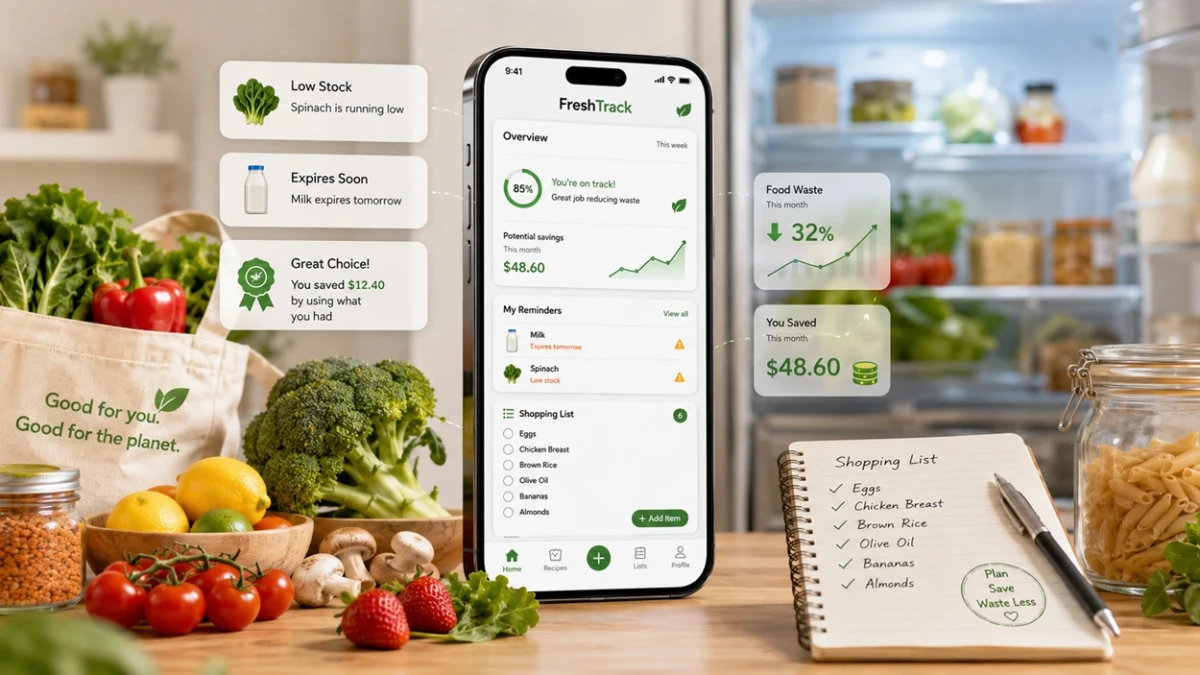
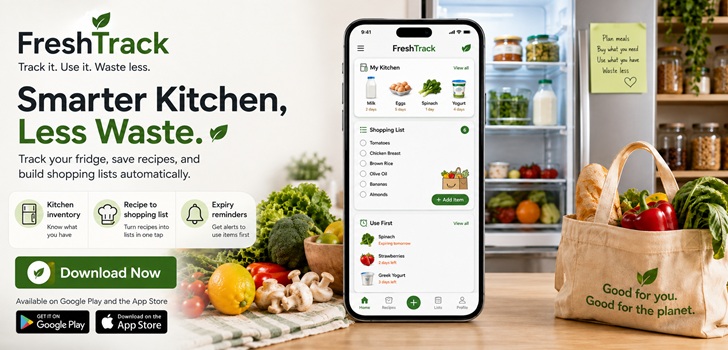
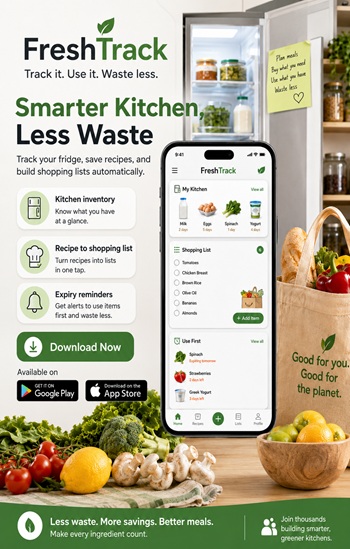
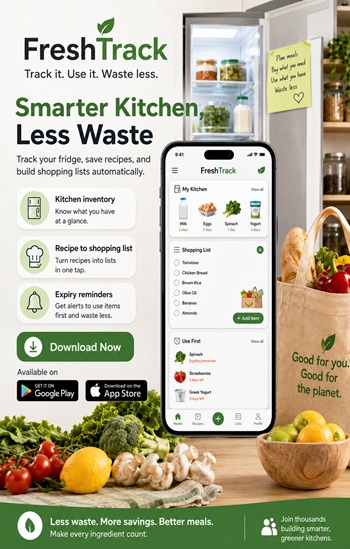
The app lets users record food stored in the refrigerator, freezer and pantry, set expiry information and receive “use soon” reminders before products go bad.
It also tracks quantities and highlights low-stock items. FreshTrack Pro can automatically add products to a shopping list when supplies run low and offers weekly waste insights showing what was used, what was discarded and where money was lost.
That means the economic value of the app is not primarily about finding cheaper groceries.
It is about getting more value from groceries that have already been paid for.
Avoiding duplicate purchases creates a second savings channel
Food expiring unused is only one form of household inefficiency.
Another is buying something that is already at home.
FreshTrack keeps a shared inventory of the refrigerator, freezer and pantry. Its recipe-import feature can read a recipe link, pasted text or screenshot and identify which ingredients are already available before creating a shopping list for the missing items.
The built-in shopping list can also restock purchased items back into the inventory, while household sharing keeps the same kitchen synchronized across multiple devices.
The App Store describes the same workflow: users can see what they already have, choose only missing ingredients and use expiry and low-stock signals to decide what to buy next.
This matters because reducing waste and reducing unnecessary purchases are economically different benefits.
A product that expires represents money lost after purchase.
A duplicate product that was never needed represents spending that potentially could have been avoided in the first place.
FreshTrack attempts to address both.
What if household food waste fell by 10% to 30%?
The global physical impact is also substantial.
Households generated an estimated 631 million tonnes of food waste in 2022.
If better planning, policy changes and digital tools collectively reduced that household total by:
10%, around 63.1 million tonnes of waste could be avoided.
20%, the reduction would reach approximately 126.2 million tonnes.
30%, it would rise to roughly 189.3 million tonnes.
A 50% reduction would mean about 315.5 million tonnes less household food waste compared with the 2022 baseline.
FreshTrack alone cannot deliver reductions on that global scale. Adoption would have to be widespread, and technology would need to work alongside retailers, food producers, policymakers and changes in consumer behaviour.
But there is evidence that large reductions are achievable.
UNEP says the UK’s long-running public-private food-waste programmes helped cut household food waste per capita by more than a quarter between 2007 and 2018. Japan has also recorded substantial progress.
UNEP in 2026 specifically highlighted the growing role of digital tools in helping households and businesses prevent food from being discarded, describing technology as potentially important to achieving the goal of halving food waste by 2030.
The economic benefit goes beyond the grocery bill
Food that reaches a household has already absorbed economic resources.
It has been grown or produced, processed, packaged, transported, stored, refrigerated and sold.
When it is discarded, the financial loss therefore extends beyond the consumer who paid for it.
UNEP estimates food loss and waste are responsible for 8–10% of global greenhouse-gas emissions, while also wasting agricultural land, freshwater, labour, energy and capital.
Reducing household waste can consequently produce several layers of economic benefit:
families buy food more efficiently;
municipalities handle less organic waste;
retail demand becomes better aligned with actual consumption;
less energy is spent producing and refrigerating food that will never be eaten;
and environmental costs associated with methane and unnecessary production decline.
This is why an app that saves a family £100 or £300 a year may have an economic impact beyond that visible household saving.
At sufficient scale, millions of small household decisions become part of a larger efficiency gain.
FreshTrack’s real test will be measurable user savings
The strongest future evidence for FreshTrack would therefore not be download numbers alone.
It would be data showing whether users actually throw away less food after using the app.
FreshTrack Pro already includes waste insights designed to show users what they consume, what they discard and what that waste costs them.
That creates an opportunity for the app eventually to measure its own economic impact.
For example, comparing a household’s first three months with its next three months could reveal whether expiry reminders, recipe planning and inventory tracking are producing measurable reductions in discarded food.
Until such independent or aggregated data exist, it would be misleading to advertise a guaranteed savings percentage.
What can be said from existing evidence is that the economic opportunity is large.
A family wasting £1,000 of edible food annually does not need to eliminate waste completely to see a meaningful difference. Cutting that loss by only one-fifth would already retain about £200 a year.
At the global level, even a fraction of the roughly $1 trillion lost annually to food waste represents tens of billions of dollars.
FreshTrack’s proposition is therefore less about creating new household income than about protecting money already spent:
buy what is needed, know what is already there, and use food before its value ends up in the bin.
Download FreshTrack:
FreshTrack for Android — Google Play
FreshTrack for iPhone and iPad — App Store
MediCenterTV.com
 Like
0
Like
0
 Dislike
0
Dislike
0
 Love
0
Love
0
 Funny
0
Funny
0
 Wow
0
Wow
0
 Sad
0
Sad
0
 Angry
0
Angry
0

Bilge Türk, MediCenterTV.com editörü, gazeteci ve yazardır. Sağlık, yaşam, bilim ve güncel gelişmeler üzerine içerikler hazırlayan Türk; doğru, anlaşılır ve toplum yararını gözeten habercilik anlayışıyla sağlık alanındaki gelişmeleri okuyuculara aktarmayı amaçlamaktadır.













Comments (0)